
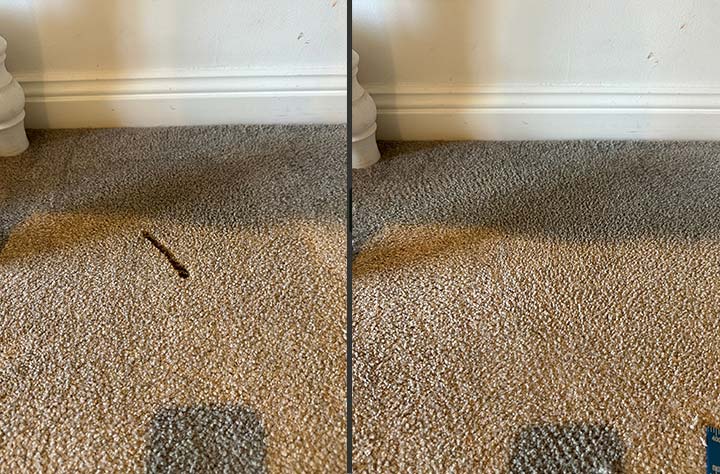
Most carpet problems you encounter in your home can be repaired without replacing the entire floor. Wrinkles, burns, stains, separated seams, loose edges, torn sections, and even small holes are all fixable when the carpet backing is still intact. The key is identifying the problem correctly and matching the repair method to the damage.
Replacing carpet is expensive and disruptive. Repairing it is often faster, cheaper, and just as effective in terms of appearance and durability. This guide covers the most common carpet problems you will face, how each one is fixed, what you can tackle yourself, and when you should call a professional. By the end, you will be able to diagnose your carpet issue and know exactly what your next step should be.
Problem 1: Wrinkles, Ripples, and Buckling
What It Looks Like
Waves or ridges running across the carpet. The carpet lifts off the floor in certain areas and creates visible bumps. This is most common in hallways and large open rooms.
What Causes It
Humidity changes cause carpet fibers and backing to expand. When the carpet cannot expand beyond the walls, it buckles upward. Improper installation using only a knee kicker instead of a power stretcher is another leading cause. Heavy furniture dragged across the floor can also pull carpet loose from the tack strips.
How It Is Repaired
The fix is power stretching. A professional releases the carpet from the tack strips along one or more walls, uses a power stretcher to pull the carpet tight, re-secures it to the tack strips, and trims the excess. A knee kicker alone cannot generate enough sustained tension and will not permanently solve the problem.
DIY Potential
Low. You can rent a power stretcher for $30 to $50 per day, but technique matters. Incorrect stretching can tear the backing or create new wrinkles. For most homeowners, hiring a professional at $80 to $150 per room is the better choice.
When Repair Will Not Work
If the carpet backing has delaminated, meaning the layers have separated, stretching will tear the carpet. Test by folding the carpet along a wrinkle and checking whether the backing layers stay bonded. If they peel apart, replacement is your only option.
Problem 2: Burns and Scorch Marks
What It Looks Like
Small blackened or melted spots from dropped curling irons, stray fireplace embers, cigarettes, or hot cookware placed on the floor. Burns range from surface scorches where only fiber tips are blackened, to deep burns that have melted carpet down to the backing.
What Causes It
Direct contact with a hot object. Synthetic carpets like nylon and polyester melt. Wool carpet chars and turns to ash rather than melting into hard beads.
How It Is Repaired
Surface scorches can often be fixed by carefully trimming away the blackened fiber tips with sharp scissors, then fluffing the area with a spoon or brush and vacuuming. Deep burns require cutting out the damaged section and patching it with a donor piece of matching carpet, typically harvested from a closet or other hidden area. The donor piece is glued or taped into place and the seams are blended.
DIY Potential
Surface scorches: High. This is a 10-minute fix with basic scissors.
Deep burns: Medium. The cutting and patching technique requires precision. Pile direction must match exactly or the patch will be visible. If you have a steady hand, sharp tools, and matching donor carpet, you can do this.
When Repair Will Not Work
If you have no matching donor carpet available. If the burn is larger than your fist. If the carpet is loop-style berber where cut loops create a visible bald spot. In these cases, a professional may have better results, or replacement may be the realistic choice.
Problem 3: Stains That Cannot Be Removed
What It Looks Like
A permanent discoloration that has resisted all cleaning attempts. Common culprits include bleach, pet urine that has altered the dye, red wine, ink, rust, and old blood stains.
What Causes It
The stain has either chemically altered the carpet dye, as with bleach, or has bonded so deeply to the fibers that extraction is impossible. In some cases, cleaning was delayed and the stain set permanently.
How It Is Repaired
Patching is the most reliable fix. The stained section is cut out and replaced with matching donor carpet, using the same technique as a burn repair. For very small stains, some professionals offer carpet dyeing, but color matching is difficult and the dyed area may fade differently over time. Patching is more predictable.
DIY Potential
Medium, same as burn patching. The critical factor is having matching donor carpet and aligning the pile direction correctly.
When Repair Will Not Work
When stains are numerous and spread across the room. Patching 10 different spots is impractical and will look obvious. When you have no donor carpet and the stain is in a prominent location. When the stain has soaked through to the padding and subfloor, causing odor or mold that requires more extensive remediation.
Problem 4: Separated Seams
What It Looks Like
Two pieces of carpet that were originally joined at installation have pulled apart, leaving a visible gap. This commonly occurs in doorways and at transitions between rooms.
What Causes It
The original seam tape adhesive has failed due to age, humidity, or heavy traffic. Poor initial installation with inadequate seam sealing can also cause early failure. Dragging furniture across seams accelerates separation.
How It Is Repaired
The carpet edges along the gap are cleaned of old adhesive. New seam tape is placed under the seam. A seaming iron heats the tape, activating the adhesive. The two carpet edges are pressed together and weighed down while the adhesive sets. The seam is then blended by intermingling fibers across the join.
DIY Potential
Low to medium. The seaming iron is a specialized tool that reaches specific temperatures. Too cool and the adhesive does not bond. Too hot and you melt the carpet backing. Seam repair in high-traffic areas demands a strong bond. For a single small seam in a low-traffic area, a careful DIYer can try it. For doorways and main living areas, hire a professional.
When Repair Will Not Work
If the edges of the separated seam are frayed with fibers pulling out, the backing at the seam has deteriorated. Re-gluing will not hold long-term. Multiple frayed seams are a sign the carpet is nearing end of life and replacement should be considered.
Problem 5: Loose Carpet Along Walls and Edges
What It Looks Like
The carpet has pulled away from the baseboard, leaving a visible gap between the carpet edge and the wall. The edge may curl up slightly.
What Causes It
The carpet has slipped off the tack strip. This happens from heavy foot traffic near walls, furniture being pushed against the edge, or the original installation not seating the carpet firmly onto the tack strip pins.
How It Is Repaired
The loose edge is lifted. The tack strip is inspected and replaced if the pins are bent or the wood is broken. The carpet is then re-stretched toward the wall using a knee kicker, hooked onto the tack strip, and tucked into the gap using a stair tool. For small sections of loose edge, a knee kicker is appropriate here because the stretch distance is short.
DIY Potential
High for small sections under a few feet. You can rent a knee kicker or buy one for $30 to $40. Work in small increments, hooking the carpet onto the pins bit by bit. If the entire perimeter of the room is loose, you need a power stretcher and a professional.
When Repair Will Not Work
If the tack strip itself is rotted, rusted, or pulling away from the subfloor. Replace the tack strip section first. If the carpet edge is frayed or the backing is crumbling, the carpet may not hold on the pins. At that point, you are looking at replacement.
Problem 6: Tears, Rips, and Holes
What It Looks Like
A linear tear from a sharp object or a hole where carpet fibers and backing have been completely removed. Pet damage, dropped knives, and furniture mishaps are common causes.
What Causes It
A sharp object cutting through the carpet fibers and backing. Pets digging or chewing. A heavy object dropped with a sharp edge. Moving furniture with exposed nails or staples.
How It Is Repaired
For small holes, patching is the standard fix. For linear tears, the edges can sometimes be re-joined with seam tape if the tear is clean and the backing is not frayed. If the tear has jagged edges or missing fibers, you may need to cut a clean square around the damage and then patch that square with donor carpet.
DIY Potential
Medium for small holes with donor carpet available. Low for long tears in visible areas. The challenge with tears is that the edges tend to fray over time, so a simple re-join may not hold. A patch is more durable.
When Repair Will Not Work
When the tear is very long, more than a few feet, in a prominent area. When multiple tears exist across the room. When pets are likely to damage the same area again.
Problem 7: Threshold and Transition Strips Coming Loose
What It Looks Like
The metal or wood strip where carpet meets another flooring type, tile, hardwood, or vinyl, has come loose, bent, or lifted. The carpet edge may be exposed and fraying.
What Causes It
Foot traffic, vacuum cleaner impacts, moisture, or the original installation using fasteners that were too short or insufficient.
How It Is Repaired
Remove the old transition strip. Inspect the carpet edge. If the edge is frayed, trim it cleanly. Install a new transition strip with appropriate fasteners driven into the subfloor, not just the carpet. The new strip should cover the carpet edge fully and sit flush with the adjacent flooring.
DIY Potential
High. This is a straightforward replacement using a hacksaw to cut the strip to length, a drill for pilot holes, and screws or nails to secure it. New transition strips cost $10 to $30.
When Repair Will Not Work
If the subfloor at the transition is damaged or uneven, the new strip may not sit flat. Subfloor repair may be needed first. If the carpet has pulled back so far that the transition strip cannot cover the gap, the carpet needs to be re-stretched toward the transition.
Problem 8: Sprouting and Pulled Loops
What It Looks Like
A single tuft or loop of carpet standing taller than the surrounding fibers. On loop carpet, a pulled loop creates a visible line across the carpet. On cut pile, a sprout looks like a single long fiber sticking up.
What Causes It
A loop getting caught on a vacuum cleaner beater bar, pet claw, or sharp object and pulling partially out of the backing. In some cases, the tuft was not properly secured during manufacturing.
How It Is Repaired
Never pull a sprout. Pulling it will unravel more of the row. Instead, trim the sprout flush with the surrounding carpet using sharp scissors. For a pulled loop on berber carpet, you may be able to work the loop back into place with a crochet hook or similar tool, though this is difficult. If the pulled loop has created a visible run, a small patch may be necessary.
DIY Potential
High for simple sprout trimming. Low for pulled loop repairs on berber carpet, which often require professional intervention to stop the run from spreading.
When Repair Will Not Work
If the pulled loop has unraveled a long row across the carpet, the structural damage may be too extensive. At that point, you are looking at a patch or, for widespread runs, replacement.
Problem 9: Furniture Indentations
What It Looks Like
Depressions in the carpet where heavy furniture legs sat for a long time. The carpet fibers are compressed and flattened.
What Causes It
The weight of furniture compressing the carpet pile and padding over months or years. The longer the furniture sits, the more set the indentations become.
How It Is Repaired
This is not a traditional repair but a restoration process. Place an ice cube on each indentation and let it melt slowly. The water absorbs into the fibers. As the fibers absorb moisture, they expand. Once the area is damp, use a spoon or stiff brush to gently lift and fluff the fibers. Vacuum when dry. For stubborn indentations, a clothes steamer or iron held above the carpet, never touching it, can relax the fibers enough to lift them.
DIY Potential
High. This costs nothing and uses items you already have at home.
When Repair Will Not Work
If the padding underneath has permanently compressed, the fibers may lift but the depression will remain because the pad has lost its resilience. If indentations reappear quickly, the padding has failed and needs replacement. If the carpet fibers are crushed and frayed from years of abrasion against furniture legs, they will not fully recover.
Problem 10: Snags and Runs in Carpet
What It Looks Like
A continuous length of yarn pulled from the carpet backing, creating a raised line across the surface. Most common in loop pile and berber carpets.
What Causes It
A sharp object catching a loop and pulling it. Vacuum beater bars are the most common cause. Pet claws, toys with sharp edges, and high heels can also catch loops.
How It Is Repaired
Stop the run from spreading by applying a small drop of fabric glue or clear nail polish at the end of the run. Let it dry. Then trim the pulled yarn as close to the surface as possible. For significant runs, a professional can sometimes re-weave the pulled section or install a patch.
DIY Potential
Medium for stopping the run. Low for making the repair invisible. Runs in loop carpet are among the hardest repairs to hide.
When Repair Will Not Work
When the run is very long or there are multiple runs. Each run represents structural damage to the carpet. Multiple runs suggest the carpet is breaking down and replacement is the realistic solution.
Problem 11: Carpet Mold and Mildew
What It Looks Like
Discolored patches, often dark green, black, or brown. A musty odor. The carpet may feel damp or the backing may be deteriorating.
What Causes It
Persistent moisture from a leak, flooding, high humidity, or wet carpet cleaning that did not dry properly. Once mold establishes in the carpet and padding, it spreads.
How It Is Repaired
For small areas, less than a few square feet, the affected carpet and padding can be cut out and replaced. The subfloor underneath must be treated with an antimicrobial solution and thoroughly dried before new padding and carpet are installed.
DIY Potential
Low. Mold presents health risks. The extent of the problem is often larger than visible on the surface. If you see mold on top of the carpet, the padding underneath is likely worse. The EPA recommends professional remediation for mold covering more than 10 square feet.
When Repair Will Not Work
When mold covers a large area or has penetrated the subfloor. When the moisture source has not been fixed. Replacement of carpet, padding, and possibly subfloor sections is required.
Carpet Repair Methods Summary
| Problem | Repair Method | DIY Potential | Approximate Pro Cost |
|---|---|---|---|
| Wrinkles and buckling | Power stretching | Low | $80-$150 per room |
| Burns and scorches | Trim or patch | High (trim), Medium (patch) | $75-$150 per patch |
| Permanent stains | Patch | Medium | $75-$150 per patch |
| Separated seams | Re-seam with tape and iron | Low to Medium | $100-$200 per seam |
| Loose wall edges | Re-kick onto tack strip | High | $50-$100 per wall |
| Tears and holes | Patch | Medium | $75-$150 per patch |
| Loose transitions | Replace transition strip | High | $30-$80 |
| Sprouts | Trim flush | High | N/A |
| Furniture indentations | Ice cube and fluff | High | N/A |
| Runs and snags | Glue and trim | Medium | $50-$100 for pro fix |
| Mold and mildew | Cut out, treat, replace | Low | $200-$500+ depending on extent |
The One Repair You Should Never Attempt
Do not try to patch a carpet using a piece of carpet from a different room, a different dye lot, or a different manufacturer. Even if the color looks close under artificial light, it will almost certainly look different under natural light or at an angle. The human eye detects boundaries between colors very effectively. A mismatched patch draws more attention than the original damage.
Always use donor carpet from the same installation, ideally from a closet or hidden area in the same room or an adjacent room with identical carpet.
Frequently Asked Questions
How much does carpet repair typically cost?
Professional carpet repair costs vary by the type of repair but generally range from $75 to $250 for most single-issue repairs. Patching, stretching, and seam work fall in this range. More extensive work or multiple repairs increase the total. Most companies charge a minimum service fee of $75 to $125.
Can I repair carpet in a rental property myself?
Check your lease first. Some leases require professional repair for any damage beyond normal wear and tear. An improperly done DIY repair that is visible during inspection could cost you more in the long run. If you do proceed, use donor carpet from a closet within the unit and take your time blending the seams.
Will repaired carpet look noticeable?
A properly executed repair on cut pile carpet using matching donor material and correct pile direction is nearly invisible. Loop pile and berber repairs are more likely to show. The skill of the person doing the repair is the biggest variable. Professionals who specialize in carpet repair achieve better cosmetic results than general handymen.
How long do carpet repairs last?
A properly installed patch, seam repair, or stretch lasts the remaining life of the carpet. These repairs do not degrade faster than the surrounding carpet. The exception is DIY seam repairs that use incorrect adhesive, which may fail within months.
Is it worth repairing old carpet?
This depends on the carpet's remaining useful life. If the carpet is 5 years old and has one burn mark, repair is clearly worth it. If the carpet is 15 years old with multiple issues and visible wear, replacement is the better financial decision. A good guideline is to avoid spending more than 30% of replacement cost on repairs to old carpet.
Can I make an insurance claim for carpet damage?
Homeowners and renters insurance covers sudden and accidental damage from covered perils. A dropped iron that burns the carpet is typically covered, subject to your deductible. Gradual damage, pet damage, and normal wear are not covered. Document the damage with photos and contact your agent before starting repairs.
Key Takeaways
Carpet repair is a viable option for most localized problems. The common thread across all repairs is that the carpet backing must be intact and you need matching material for any patching work. Wrinkles need stretching, not replacement. Burns and stains need patching, not a whole new floor. Seams and edges can be re-secured.
Before you call anyone, identify the problem. Check the backing. Find your donor carpet if a patch is needed. Then decide whether the repair is within your DIY comfort zone or requires a professional.
The most expensive mistake you can make is replacing an entire room of carpet when a $100 repair would have solved the problem. The second most expensive mistake is attempting a repair you are not equipped to do and making the damage worse. Be honest about your skills, and when in doubt, get a quote from a carpet repair specialist before you commit to replacement.