
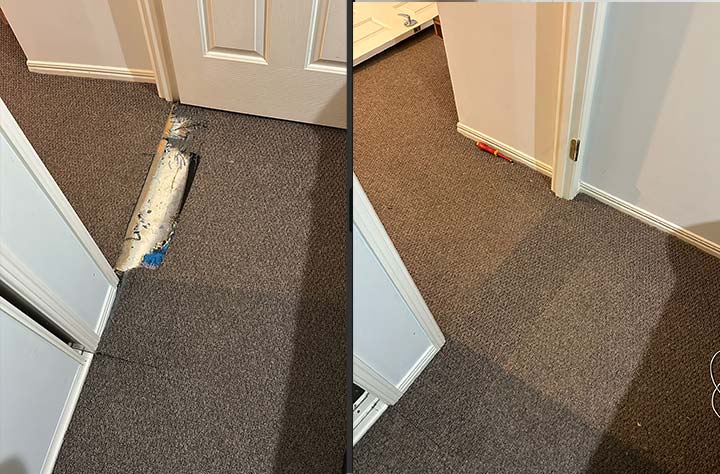
Most damaged carpet can be repaired, not replaced. The deciding factors are the type of damage, the age of the carpet, the condition of the backing, and whether you have matching donor material available. Carpet that is less than 10 years old, structurally intact, and has localized damage is almost always a candidate for repair. Carpet that is delaminated, faded beyond matching, or worn to the point of bare threads usually needs replacement.
Replacing wall-to-wall carpet costs between $3 and $7 per square foot installed, according to 2024 data from HomeAdvisor. For a 200-square-foot living room, that is $600 to $1,400. A repair of that same carpet, depending on the issue, might cost you $80 to $250 if you hire a professional, or under $50 if you do it yourself. The financial incentive to repair is substantial. But saving money only makes sense if the repair will last and look acceptable. Let's go through the signs that tell you repair is the right path, and the warning flags that signal it is time for replacement.
First, Check the Carpet Backing
Every repair decision starts with the backing. If the backing has failed, nothing else matters. You cannot repair carpet that is structurally unsound.
How to Perform the Delamination Test
Go to a corner of the room or an area near a heat vent where you can easily lift the carpet edge. Fold the carpet back and look at the underside. You should see two distinct layers bonded together: the primary backing that holds the fibers and the secondary backing that gives the carpet weight and stability.
Try to separate these two layers with your fingers. If they peel apart easily, like separating two pieces of paper that were lightly glued, your carpet has delaminated. The latex adhesive that holds the backing layers together has failed. This happens due to age, excessive moisture, or manufacturing defects.
Delaminated carpet cannot be stretched. It cannot be seamed. It will tear during any repair attempt. If you see this, you are looking at replacement, not repair.
What Healthy Backing Looks Like
Healthy backing feels firm and unified. You cannot dig your fingers between the layers. The latex may appear slightly yellowed with age, but it still holds tight. Carpet with intact backing is eligible for patching, stretching, and seam repair.
Sign 1: You Have Localized Damage, Not Widespread Wear
This is the single most important distinction. Repair is for specific problem spots. Replacement is for carpet that is uniformly worn out.
Damage That Can Be Repaired
Think of damage as an event. Something happened to a specific spot.
- A burn from a dropped curling iron
- A stain that bleaching or cleaning cannot remove
- A tear from moving furniture
- A pet chewing or scratching one area
- A seam that has separated
- Wrinkles or ripples from humidity changes
- A bleach spot from a cleaning product spill
Each of these affects a defined area. The rest of the carpet is fine. You can cut out the damaged section and patch it with donor carpet from a closet or other hidden area. You can re-stretch the wrinkles. You can re-glue the separated seam.
Wear That Requires Replacement
Wear is different. It is uniform degradation across the entire floor.
- Traffic lanes that have worn down to the backing
- Carpet that feels hard and flat even after deep cleaning
- Color that has faded evenly across sun-exposed areas
- Matting that does not respond to pile lifting or grooming
- Carpet in a rental that is 15-plus years old and has seen multiple tenants
Wear means the entire carpet has reached the end of its service life. Patching one worn spot creates a visible mismatch because the new donor piece has full pile height while the surrounding carpet is flattened. You will trade one eyesore for another.
Sign 2: You Have Matching Donor Carpet Available
Successful patching requires an identical match. Same fiber, same color, same dye lot, same wear.
Where to Find Donor Carpet in Your Home
The best donor sources, in order of usefulness:
- A closet using the same carpet. Walk-in and reach-in closets are gold. The carpet inside has seen almost no traffic or UV exposure. It is as close to new as you will find.
- Under a large piece of furniture that has never moved. A bookshelf, an entertainment center, or a bedroom dresser that has sat in the same spot since installation.
- Stair risers, if carpeted. The vertical portion of a stair step is rarely walked on.
- Leftover remnants. Check your attic, basement, or garage. Installers often leave remnants from the original job.
What If You Have No Donor Carpet?
If you have no donor piece, your options narrow. Some installers can order a small piece from the manufacturer if the carpet is still in production. Give them the brand, style name, and color number from the original installation paperwork. Without that information, matching is nearly impossible due to dye lot variations.
If the carpet is discontinued and you have no donor piece, repair is still possible for some issues. Seam separation does not require donor carpet. Wrinkle stretching does not require donor carpet. But a hole, burn, or permanent stain does. For those, no donor carpet means you are looking at replacement, or living with the damage.
Sign 3: Seams Are Separating, Not Fraying
Seam separation is one of the most common repair calls. It is also one of the most straightforward fixes when caught early.
Repairable Seam Separation
A seam that has simply pulled apart, with the two edges still clean and the backing intact, is repairable. The technician cleans out old adhesive, applies new seam tape, and re-joins the edges with a seaming iron. The repair takes less than an hour for a single seam. Cost typically ranges from $100 to $200.
You can identify this type of separation by looking at the edges of the gap. If you see clean, straight carpet edges with no missing fibers, it is likely repairable.
Seams That Signal Replacement
If the edges of the separated seam are frayed, with fibers pulling out along the length of the gap, the carpet backing at the seam has started to disintegrate. Simply re-gluing the seam will not hold. The weakened backing will continue to fray, and the seam will open again. This is more common in older carpets or carpets that were cut with dull blades during original installation. Frayed seams on multiple seams usually mean the carpet is nearing end of life.
Sign 4: Wrinkles Are Caused by Tension Loss, Not Backing Failure
Carpet wrinkles and ripples are usually fixable. We covered this in detail in the carpet stretching article, but the repair-versus-replace decision hinges on one test.
Test Before You Decide
Pinch the carpet on either side of a wrinkle. Try to fold it along the peak of the ripple. Look at the back side of the carpet as you fold it.
If the backing layers stay firmly bonded as you flex the carpet, the wrinkles are caused by tension loss. This is repairable through power stretching. The carpet itself is still healthy.
If the backing separates or cracks when you flex the wrinkle, the carpet is delaminating. Stretching will tear it. Replacement is your only option.
Sign 5: Stains and Spots Are Containable
Not all stains can be removed, but a stain that will not come out does not automatically mean you need new carpet. The question is whether you can hide or remove the stained section.
When Patching Makes Sense
A single bleach spot, an old pet stain that has bleached the dye, or a permanent ink stain in one location are all candidates for patching. Cut out the stained square and insert a donor piece. If the stain is small, under three inches across, and the donor match is good, the repair becomes invisible.
When Stains Mean Replacement
Multiple permanent stains spread across the room. Pet urine that has soaked through to the subfloor in numerous locations. These situations require so many patches that the carpet starts to look like a quilt. The labor cost of multiple patches can also approach the cost of new carpet in a small room. At that point, replacement makes more financial and aesthetic sense.
Sign 6: Your Carpet Is Under 10 Years Old
Carpet age is a guideline, not a rule. But it is a useful reference point.
Most residential carpet has a design life of 10 to 15 years according to the Carpet and Rug Institute. High-quality nylon carpet can last 15 to 20 years with proper maintenance. Low-cost polyester or olefin carpet may show significant wear at 5 to 8 years.
A 5-year-old carpet with one burn mark is an obvious repair candidate. A 20-year-old carpet with multiple issues and visible traffic patterns is a replacement candidate. The gray area is the 10-to-15-year range. In that window, you need to weigh the cost of repair against how many more years you realistically expect the carpet to last.
If you repair a 12-year-old carpet and it wears out two years later, you effectively wasted the repair money. Be realistic about remaining useful life.
Sign 7: The Subfloor Is Undamaged
Lift a corner of the carpet and look at what is underneath.
Subfloor Issues That Complicate Repair
Water damage that has warped or rotted the subfloor. Mold growth on the subfloor or padding. Severe pet urine saturation that has stained and de-laminated the subfloor material. These situations require subfloor repair or replacement before any carpet work can proceed.
If the subfloor damage is localized, you can repair the subfloor section and then repair the carpet over it. If the subfloor damage is widespread, you are probably pulling up all the carpet anyway. At that point, replacement becomes the default choice.
Repair Versus Replacement Decision Framework
Use this table to quickly assess your situation.
| Condition | Repair Likely Possible | Replacement Likely Needed |
|---|---|---|
| Carpet age | Under 10 years | Over 15 years with visible wear |
| Damage type | Localized (burn, stain, tear, seam) | Widespread (traffic wear, matting, fading) |
| Backing condition | Firm, layers bonded | Delaminating, brittle, crumbling |
| Donor carpet available | Yes, from closet or remnant | No, and damage requires a patch |
| Seam condition | Clean separation | Frayed edges, multiple failing seams |
| Number of damaged areas | 1-3 isolated spots | More spots than you can count |
| Subfloor condition | Clean, dry, intact | Water damaged, moldy, rotting |
| Padding condition | Still resilient | Compressed, disintegrated, saturated |
What You Can Repair Yourself Versus What Needs a Pro
Some carpet repairs are within reach for a careful DIYer. Others are not.
DIY-Friendly Repairs
- Surface scorch trimming on small burns
- Small patch installations (under 4 inches) with clear donor carpet
- Minor seam re-gluing in low-traffic areas
- Threshold transition strip replacement
Repairs Best Left to Professionals
- Power stretching for wrinkles
- Large patches in high-visibility areas
- Seam repair that requires a seaming iron and specialized tape
- Any repair on patterned or berber carpet
- Repairs where you have no matching donor piece and need creative sourcing
The most common DIY repair mistake is cutting too deep into the backing when trimming or creating a donor hole. This damages the structural integrity of the carpet and turns a small repair into a larger problem. If you are not confident making precise, controlled cuts, hire someone.
When Replacing Is the Smarter Long-Term Decision
Sometimes the most helpful advice is knowing when to stop trying to fix something.
Replace your carpet rather than repair it when:
- The cost of multiple repairs exceeds 50% of new carpet cost for that room
- The carpet is delaminated in more than one area
- You cannot source a match and the damage is in a visible location
- The padding has failed and needs full replacement anyway
- You are preparing to sell your home and the carpet is visibly aged
- You have allergy concerns and the existing carpet has trapped years of dust and allergens that cleaning cannot fully remove
There is no virtue in repairing carpet that will look bad or fail soon. A clean, new, inexpensive carpet often looks better than a patched, tired old one.
Frequently Asked Questions
Can stained carpet be dyed instead of patched?
Carpet dyeing exists as a service, but it has significant limitations. It works best on light stains on solid-color nylon carpet. It does not work well on bleach spots where the original color has been chemically stripped. It cannot restore pattern. Color matching is difficult, and the dyed area may fade differently over time. For most homeowners, patching is a more reliable solution than dyeing.
How do I know if my carpet is wool or synthetic?
Pull a few fibers from an inconspicuous area and hold them to a flame. Wool burns slowly, smells like burning hair, and leaves a soft ash. Synthetic fibers like nylon or polyester melt, bead up, and smell like burning plastic. Do this test with tweezers over a non-flammable surface. Never touch the melted synthetic bead with bare fingers. It will burn you severely.
Can I patch carpet if the donor piece is a slightly different color?
Even a slight color difference will be visible because the patch has distinct edges. The eye is very good at detecting boundaries between two similar colors. You can sometimes minimize this by pulling individual fibers from the donor piece and the surrounding carpet and intermingling them across the seam, but this is tedious and rarely produces a truly invisible result. If the match is not exact, expect the repair to be noticeable.
Will my home insurance pay for carpet repair or replacement?
Standard homeowners insurance covers sudden and accidental damage from covered perils like fire, burst pipes, or falling objects. It does not cover gradual wear and tear, pet damage, or maintenance issues. If a candle started a small fire that burned a section of carpet, that is likely covered, minus your deductible. If your carpet is just old and worn, insurance will not pay. Always check your policy or call your agent.
How long does a carpet patch repair last?
A properly installed patch in a healthy carpet lasts the remaining life of the carpet. It does not weaken the surrounding area. It does not come loose over time when installed with proper seam tape or adhesive. The patch itself is as durable as the original carpet.
Can stretching fix wrinkles on carpet that is glued down?
No. Stretch-in carpet uses tack strips around the perimeter. Glue-down carpet is adhered directly to the subfloor. Wrinkles in glue-down carpet usually mean the adhesive has failed. The repair involves lifting the loose section, scraping the old adhesive, and re-gluing it with proper carpet adhesive. If large sections have released, replacement may be more practical.
Key Takeaways
Most carpet damage is repairable if the backing is intact and you can source matching material. Start your assessment by checking the backing for delamination. Then identify whether you are dealing with isolated damage or widespread wear. Find your donor carpet before you cut anything.
The age and quality of your carpet should factor into your decision honestly. Spending $200 to repair a carpet that will need replacement in two years is a personal choice, but you should make it with full awareness of the trade-off.
When the math works, repair is significantly cheaper than replacement and can extend the life of your carpet by years. When the carpet has reached the end of its design life or the backing is failing, put your money toward new flooring instead.
Go pull up a corner in a closet. Check that backing. Then count your damaged spots. You will probably find that your carpet is more salvageable than you thought.